The best logs
This week, we invite you to rediscover the best Tara Oceans logs, from September 2009 to March 2012.
Happy reading!
March 2012
Thank you Lorient!
Today, Saturday, March 31, 2012, Tara came back to her home port after a two-and-a half-year expedition covering 115,000 km. A passionate reunion shared with the people of Lorient who gave us a wonderful welcome, full of respect and fervor. We were accompanied by well-wishers and Breton bagpipes for most of the afternoon under a generous sun, from Groix Island to the Belem dock where we are now moored. read moreMarch 2012
The last stationSaturday, March 24, 2012 was a real milestone. In the Atlantic Ocean, 300 nautical miles from the Spanish coast, the Tara Oceans Expedition ended. This was the 153rd and last station of an extraordinary adventure: Two-and-a-half years of collecting marine organisms in oceans all over the world.
read more February 2012
Ban Ki-moon at sea on TaraA historic day for Tara Expeditions. After a press conference Thursday at the United Nations where Eric Karsenti, scientific director, presented Tara Oceans Expedition, today Tara experienced a landmark event.
Ban Ki-moon, Secretary General of the United Nations, headquartered in New York, came aboard Tara early Saturday afternoon.
read more
February 2012
Tara docked in NYC at the foot of Freedom TowerSunday morning around 6:30, with the brilliant sun scarcely compensating for the 2° C temperature, Tara began her final approach to New York City. The first skyscrapers began to appear on the horizon, breaking the surface of the ocean where we'd seen no construction for eleven days. We were still 25 nautical miles from New York, about 45 kilometers.
read more February 2012
Tara coasts on the Gulf StreamDue to its spherical form, the earth receives more solar radiation in the tropical zones than in the temperate and sub-polar zones. This situation in the long term results in intense warming at the inter-tropical zones and glaciation in the higher latitudes. Fortunately for life on earth, winds and marine currents distribute this warmth over the entire planet. Oceanic surface and deep circulations transport excess and deficit heat from one region to another.
read more December 2011
From one ocean to another
During Tara’s long journey since leaving Lorient in September 2009, the sailboat- laboratory has passed through many legendary places and had some very memorable experiences. Going through the Panama Canal has just been added to the list. This morning we left the Pacific Ocean, and now we’re here on the other side of the continent, sailing in Atlantic waters.
read more
December 2011A very special Christmas While our families and friends on the other side of the world were preparing
traditional holiday festivities, a scent of exoticism floated on the deck of Tara in preparation for a very unusual Christmas. Beneath the coconut trees of Panama, it’s not easy to feel the holiday spirit !
read more Decembee 2011
A Day on Clipperton – almost.The entire crew was waiting impatiently to spend a day on Clipperton, this tiny island lost in the middle of the North Pacific Ocean. A mixture of excitement, but also apprehension: would we be able to set foot on this legendary island? Would the sea allow us this chance? Find the answer in the following account of a very unusual day.
read more October 2011Plastic Continent Ahoy!On Tuesday October 4, as we reach latitude 31º N, for the first time we encounter some floating plastic rubbish. We’ve arrived at the “Great Pacific Garbage Patch”. It’s a first “triumph” because the studies on plastic distribution in the north Pacific by the Charles Moore Algalita Foundation (1999-2008) showed unpredictable locations.
read more September 2011
Hawaii, Last Stop in Polynesia
Under the starry sky, a halo of light tells us we’re approaching Honolulu. With sails trimmed (since one got torn) Tara glides slowly through the water. We’re finally reaching Hawaii after more than 3 months navigating around Polynesia. Our route has paralleled that of the first great navigators – not the first European explorers, but the Austronesians who voyaged in pirogues more than 2,000 years ago, without even a compass (not to mention GPS or VHF) and gradually peopled these far-flung islands. Those early sailors had a remarkable knowledge of the sea: they navigated by observing the sun, reading the waves and dominant winds, and following the “paths of the stars”—natural guides transmitted by their ancestors.
We spent long hours poring over maps that show the immense distances between Pacific islands.We imagined with admiration the difficulties facing our predecessors, expert sailors who set out to discover distant islands where they might settle. This morning Hawaii finally appears before us – the northernmost corner of the Polynesian triangle, one of the last conquests of the ancient “people of the sea”.
read moreAugust 2011Tara Oceans: A 3rd year in the Northern Hemisphere!It’s already been 2 years since the Tara schooner set sail over all of the world’s oceans. September 5, 2011 will mark the beginning of Tara Oceans 3rd expedition year. This 3rd act will take place in the Northern Hemisphere.
The program: Tara will cross Hawaiian waters, explore the North Pacific “Plastic Continent”, head towards San Diego, and pass through the Panama Canal before reaching New York. In 2012, Tara will cross the Atlantic in the spring before rejoining its naval base at Lorient.
read more
April 2011
The hundredth scientific station* kicks off.
Yesterday morning at 9.30, the rosette was immersed into a fairly choppy sea in the middle of the South Pacific Ocean, kicking off the hundredth scientific station. Operations should have begun 24 hours earlier but the small cyclonic whirlpool from which the scientists wanted to take samples had migrated a little further north. After a night of additional sailing Tara is now floating at the heart of this whirlpool - 55km in diameter and situated 1,200 nautical miles off the coast of Ecuador. read more
March 2011
Flags of the world aboard Tara
Paths crossed
Currently at Easter Island, Tara welcomes aboard Leila Tirichine, researcher and Lee Karp-Boss, chief scientist.
If Leïla and Lee had to display the colours of their country, it would be difficult for them to choose one single flag. Following the tradition aboard Tara, they would hoist the flag of their country of origin, plus another one in honour of their host country. And stored in a trunk, they would keep the flags of all the countries they’ve visited... read more
February 2011
Etienne Bourgois and Eric Karsenti aboard Tara
It’s the first time that Etienne Bourgois and Eric Karsenti, the two co-directors of the Tara Oceans expedition, have found themselves together onboard Tara at the same time. This trip is an opportunity for them to discuss a number of issues and make plans with the current team. At the end of March Tara Oceans will celebrate its one and a half year anniversary since departing from Lorient on September 5th, 2009. This is a chance to assess what progress has been made as we near the midway point, and discuss the future. read more
Décembre 2010
Tara and the second element,
according to Christian de Marliave (alias “Cricket”), polar specialist.
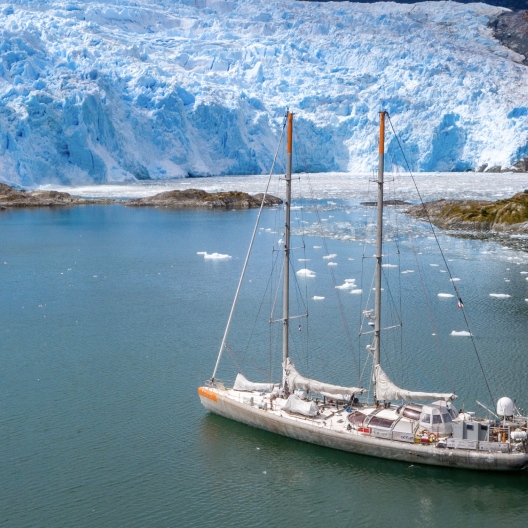
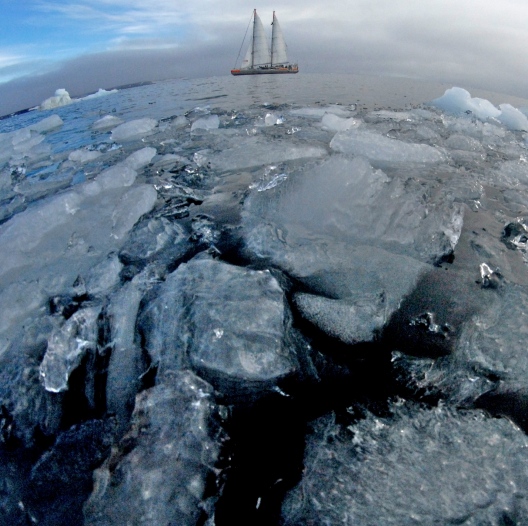
Since our departure from Cape Town for this 2nd expedition year, Tara has Antarctica in sight before reaching the Pacific. For the schooner and part of her crew who participated in the Arctic Drift, this voyage will have an aura of reunion with the polar environment, and with ice, Tara’s second element. read more
September 2010
A second year of expedition gets underway
On 5 September 2010, exactly one year after setting sail from the port of Lorient in Brittany, France the Tara Oceans Expedition will leave Cape Town, South Africa heading east into the second of its planned three year journey.
During this second year, Tara will cross the Atlantic and Pacific Oceans, from east to west, sailing from Cape Town to arrive in Auckland, New Zealand in August, 2011. read more
May 2010
We have a “little” scare on TaraTuesday 25th May, 1.40pm. Drifting at latitude 13°06' South, longitude 46°58' East, Tara’s scientists are busy at work. Hervé, the captain, climbs on deck: « Everyone stop what you’re doing, we’re getting out of here!
». read more
March 2010
The great "bloom" day
An explosion of life right in the middle of the ocean, the planktonic efflorescence generally known as "bloom" reached its climax in the Omani sea, just as Tara was cruising in its waters. In other words, this brought great satisfaction to the researchers on board. read more
February 2010
Abdou, son of Obock
Since leaving the port of Djibouti, Tara has anchored many times, searching for the most beautiful coral sites in the bay of Tadjoura. Fifteen dives have already been made and over 200 samples have been collected. read more
January 2010
Tara generation
Tara has a mission: Sensitizing youngsters to the environmental concerns of our century, and explaining to them what exactly it is that Tara's scientific team is doing and striving to achieve in the marine environment. Throughout the expedition, all in all, 150 classes will have paid a visit to Tara. read more
January 2010
The adventures of Hubert the protist
The charming creature in the picture gazing at us lovingly is known as a protist. It's true name is Lithoptera müelleri, but to make it easier, we'll just call him Hubert. read more
December 2009
The Suez Canal
The Suez Canal, a waterway which cuts through the desert, is more often than not seen as a sort of "marine highway", what with its colossal dimensions, its massive display of industry and organisation and its picnic areas –such as the lake in which Tara rested last night. read more
December 2009
Upon Lebanese waters and ground, were the last adventurers to be found. read more
November 2009
Unloading Tara’s treasures
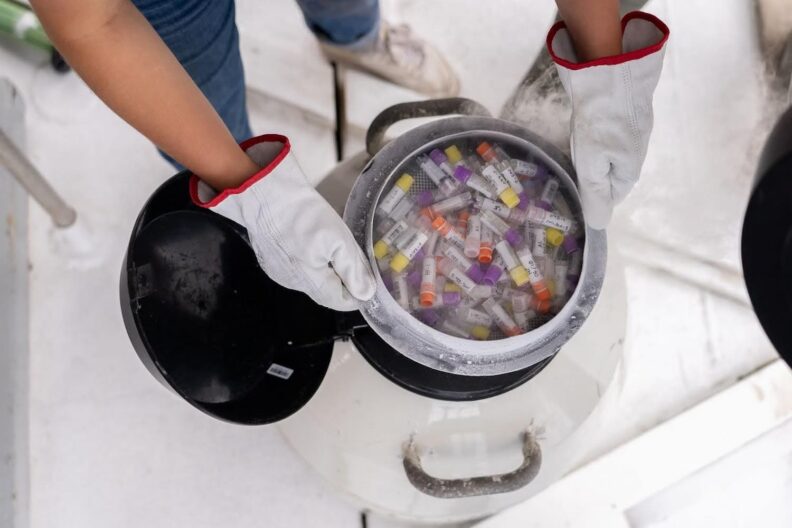
Every 4 to 6 weeks, the precious samples collected by the scientists onboard Tara are delivered ashore and sent away to be analyzed in labs all over the world.
What follows is a recap from the exchange which took place during our stopover in Dubrovnik (Croatia) with Rainer Friedrich, the man in charge of the transfer and delivery of these hundreds of vials and bottles filled with plankton. read more
September 2009
What are we seeking?
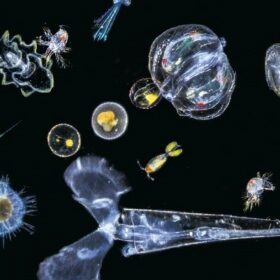
We are seeking the tiny and the overlooked, the basis of the global food chain: the species that make up the plankton.
Yes, because the plankton is not a species by itself. This term comes from Greek planktos, which means: "drifting". Plankton is a group of animals, plants, viruses, and bacteria that leave themselves to be drifted in ocean currents. On board, we are equipped with several plankton traps: nets and filters that can sort out the organisms according to their size and collect them separately.
We focus on 4 categories... read more
TARA OCEANS
A unique expedition
On 5 September 2009, at noon, the Tara boat has departed from Lorient for a three-year expedition on all the world’s oceans. read more